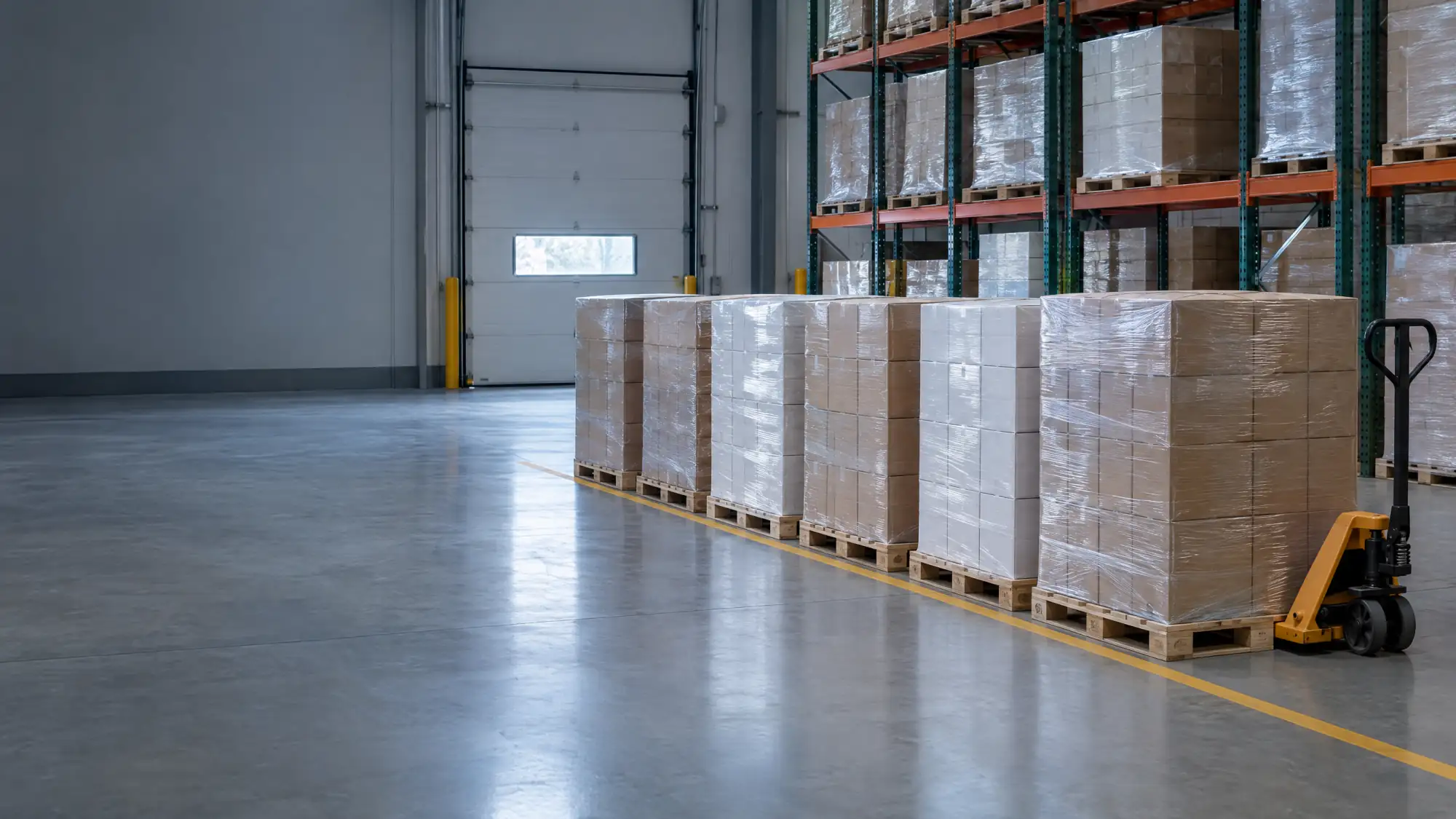
Six shrink-wrapped pallets of plain cartons staged in a row on a clean warehouse floor, with pallet racking and a closed dock door behind them
3PL services, Southern California

3PL services for natural brands, built so your POs land on time

Fr8topia arranges storage and freight for natural brands in Southern California. It handles the retail paperwork too. Your product sits in the same region as the KeHE, UNFI, and Target buildings it ships to. One team books the appointment, checks the routing guide, and keeps the records.

  • Dry, chilled, and frozen storage
  • Delivery appointments booked for you
  • Vetted carrier network
  • A reply within 2 business hours

Licensed and bonded freight broker in Valencia, CA  ·  NMSDC minority-certified  ·  CarrierSource Top Brokerage 2026

What does your week look like with one team on storage and freight?

Your trucks from the co-packer are received and put away. Orders ship from stock on carriers we book, and the delivery appointment is set before the truck is. The bill of lading and proof of delivery stay on file. The hours you spent chasing trucks and portals go back to you.

One PO, before and after

Before

  • Emails about where the truck is and who booked the appointment.
  • A missed delivery window and a reschedule fee.
  • A deduction notice and a short-paid invoice.

With one team

  • The appointment is booked first, and the order is delivered inside the window.
  • The paperwork matches the PO, so the invoice can be paid in full.
  • The drive from storage to the distributor DC is short.

Fr8topia is a licensed and bonded freight broker in Valencia, California. It arranges food-grade storage for natural brands through its Southern California network. It books the freight out of that storage through a vetted carrier network. Orders go to KeHE, UNFI, Target, and natural grocery.

Most brands at this stage hire a warehouse and a trucking company as two jobs. When a PO runs late, each one points at the other, and you are the one emailing both. Here one team plans the storage and the truck, so there is one contact when something changes.

How do your POs land inside the delivery window?

We work back from the date on the PO. The delivery appointment is booked first, and the truck is booked to fit it. Product is already in storage in Southern California, so the order is picked and staged before pickup day. That leaves fewer reasons to ask your buyer for an extension.

  • The date on the PO. Every distributor PO carries a delivery window, and arriving early can count as a miss too. See MABD explained.
  • The appointment. Distributor DCs receive by appointment, and each one sets its own lead time. KeHE's rules are in KeHE appointment rules and late fees.
  • The truck. We pick the carrier from a vetted network for that lane and that appointment: LTL for a few dry pallets, refrigerated LTL for chilled and frozen.
  • The load. When several orders go to the same DC, they can ride together on one appointment through a retail consolidation program.

The appointment is booked first. The truck is booked to fit it.

Nobody can promise a truck will never run late. What we can do is take out the usual causes: no appointment, an appointment made too late, or an order that was not ready when the driver arrived.

How does this cut chargebacks, deductions, and short-pays?

Most freight-caused deductions start before the truck leaves. The load was late, it had no appointment, the labels were wrong, or the paperwork did not match the PO. We check each shipment against the distributor's current routing guide first. We also keep the documents that show what shipped and when it arrived.

  • Routing guide check. Pallet build, labels, and paperwork are checked against the distributor's current guide. Receiving details are on the KeHE and UNFI pages.
  • Paperwork that matches. The bill of lading, the PO, and the case count have to agree before the driver signs.
  • Records on file. The bill of lading and proof of delivery are kept. When a deduction shows up weeks later, you have something to send back.

Most freight-caused deductions start before the truck leaves.

What wins back a shortage deduction?

A shortage deduction says the distributor received less than you shipped. It is often the easiest kind to win back, if you have the proof. That proof is a signed bill of lading or proof of delivery that shows the full count. If the signed copy does not list each item, an itemized packing slip fills the gap.

Each distributor and retailer gives you a set window to dispute a deduction, and some are short. Proof that takes a week to find can miss it. That is why we keep the bill of lading and proof of delivery for every load on file, ready to send the day a deduction lands. If a cold load is refused at the dock, the rejected refrigerated load playbook covers what to do next.

Some deductions have nothing to do with freight. Pricing, promotions, and trade spend sit with your sales team and your distributor. We will tell you which ones the freight side can fix. If you want a read on your current setup, start with a free routing guide audit or the UNFI and KeHE compliance hub.

Which fees on your invoice does this help you avoid?

Four fees come up most: late delivery, arriving with no appointment, rescheduling, and not showing up. Each one traces back to how the appointment was booked and kept. Since one team books both the appointment and the truck, those are the fees this setup is built to prevent.

Fee on your invoiceWhat usually causes itWhat we do about it
Late deliveryThe truck misses the window on the PO or the appointment time.Work back from the PO date, and stage the order before pickup day.
Unscheduled deliveryThe truck arrives with no appointment on file.Book the appointment before the truck, and confirm it before the truck leaves.
RescheduleThe appointment is moved too close to the delivery date.Book early enough that the date holds, and flag a problem while it can still be moved.
No-showAn appointment is booked and no truck arrives.One team holds both the appointment and the carrier, so neither is booked without the other.

Fee names, amounts, and cutoffs come from each distributor's current routing guide, and they change. To see what freight and fees do to your margin per case, use the landed freight cost guide.

What changes from the week you have now?

The same work still has to happen, and one team that does it every day takes it over. Today you are the link between the co-packer, the warehouse, the carrier, and the distributor's portal. After the change, you send the PO and get a confirmed appointment back.

Part of the weekBeforeWith one team
Trucks in from the co-packerYou line up the truck and tell the warehouse it is coming.We book the truck and plan the receiving slot together.
Orders going outYou get quotes, pick a carrier, and hope the order is picked in time.The order is staged and the carrier is booked by the same team.
AppointmentsYou book them in each distributor's portal, or find out late that nobody did.We book the appointment and send you the confirmation.
PaperworkBills of lading and delivery receipts sit in three inboxes.The bill of lading and proof of delivery are kept on file in one place.
A deduction shows upYou dig for proof weeks after the delivery.You ask us for the records on that shipment.
Something changesYou call the warehouse, then the carrier, then the buyer.You call one contact.

How close is the storage to KeHE, UNFI, and Target DCs?

Storage is in Southern California, the same region as the KeHE and UNFI distribution centers that serve it. A short last leg means less time on the road between your pallets and the dock. Tell us which DC you ship to, and we will give you the drive distance with your quote.

Being close also helps when a date moves. If a buyer pulls a PO forward or an appointment opens up, product that is already nearby can make it. Product that is still a day away usually cannot.

See where the distributor buildings are on the Southern California retail logistics map. If your Target loads move through a consolidator, include that in your quote request.

Can you store dry and chilled product with one team?

Yes. Our Southern California network has two sites, one cold and one dry. Frozen product holds at -10°F, chilled product at 34 to 38°F, and dry goods up to 65°F. A brand with a shelf-stable line and a cold line keeps both with one team and ships them on one plan.

  • Lot and date tracking. Storage includes lot and date tracking, with FEFO rotation so short-dated product ships first.
  • Counts you can see. Inventory reporting and cycle counts are part of storage.
  • Freight in and out. Full truckloads come in from your co-packer. Orders go out as LTL, refrigerated LTL, or a consolidated load.
  • Chilled, above refrigerated. Some products hold above refrigerated temperatures, such as 40 to 60°F. Tell us the range yours needs, and we will confirm the fit before you move anything.
  • Product that must not freeze. Dry storage holds up to 65°F. If your product must not freeze, say so in your quote request.
  • Lot holds. If you need to hold and release a specific lot, tell us how you do it today. We will confirm how it would work before you start.

Temperature zones, handling, and short-term terms are covered on the warehousing and cold storage page.

Who handles the EDI, labels, and paperwork?

We do the freight paperwork: the bill of lading, the delivery appointment, and the proof of delivery, all kept on file. Storage includes ASN-ready documentation and custom labeling. EDI, system connections, and label specs depend on your setup, so we confirm them on your quote call.

  • EDI. Send the transaction sets you use, such as 940, 945, 943, 944, 856, and 846. We will confirm which are supported before you commit.
  • Your system. Tell us what you run today, such as NetSuite or a third-party EDI tool.
  • Carton and pallet labels. Custom labeling is available. Send the label spec each customer requires, including any SSCC labels.
  • Daily pickups. Tell us how many pickups you need each week and when your carriers arrive.
  • Certifications. Tell us which certifications your customers require.

Who is this built for?

It is built for natural and organic food and beverage brands that ship into distributors every week. Most have one person running supply chain. If that person spends more time on trucks and portals than on planning, this is the setup we built.

Built for

  • Natural and organic brands shipping into KeHE, UNFI, Target, and natural grocery
  • Brands with both a shelf-stable line and a chilled or frozen line
  • A few truckloads in each month and several LTL orders out each week
  • Teams where one person handles freight, storage, and deductions

Not the right fit

  • Shippers moving tens of thousands of pallets of shelf-stable or household goods
  • Refrigerated lanes far outside the West
  • Brands that want software to dispute deductions after the fact
  • Brands looking for an outsourced sales team. Fr8topia is a freight broker.

What do you send us for a quote?

Seven details are enough for a storage and freight plan. A spreadsheet or a few lines in an email is fine. If you have a recent deduction or fee you could not explain, send that too, and we will look at what caused it.

  • Your products and the temperature each one needs.
  • Pallets in storage, split by dry, chilled, and frozen.
  • What comes in: truckloads per month and where they come from.
  • What goes out: orders per week, their size, and who receives them.
  • Lot, date, and label rules your customers hold you to.
  • Your order system, and how you send orders today.
  • Your start date, and where the product sits now.

Get a storage and freight quote

Tell us what you store and where it ships. Our team responds within two business hours.

Pricing depends on your pallet counts, temperatures, and order volume. We lay it out in your quote.

Or call (909) 304-1068, Monday to Friday, 8 to 5 Pacific.

Frequently asked questions

Who handles my routing guide and appointments?
Fr8topia does. We check each shipment against the distributor's current routing guide before it ships. We book the delivery appointment, then book the truck to fit it. The bill of lading and proof of delivery are kept on file.
How close is the warehouse to KeHE and UNFI DCs?
Storage is in Southern California, the same region as the KeHE and UNFI distribution centers that serve it. Tell us which DC you ship to, and we will give you the drive distance with your quote.
Can you store dry and chilled product in the same place?
Yes. Our Southern California network has two sites, one cold and one dry. Frozen product holds at -10°F, chilled product at 34 to 38°F, and dry goods up to 65°F. You deal with one team for all of it. If your product needs a range in between, tell us, and we will confirm the fit before you commit.
Can you hold a lot?
Storage includes lot and date tracking and FEFO rotation, so short-dated product ships first. If you need to hold and release a specific lot, ask us on your quote call. We will confirm how it works before you start.
Do you support EDI?
Storage includes ASN-ready documentation today. EDI support depends on your transaction sets and your order system. Send us the sets you use, such as 940, 945, and 856. We will confirm what is supported before you commit.
Will this stop my chargebacks?
No one can promise that. The process is built to prevent the ones freight causes: late deliveries, missed appointments, and paperwork that does not match the PO. Deductions for pricing, promotions, or trade spend come from somewhere else, and we will tell you which is which.
What do I need to dispute a shortage deduction?
A signed bill of lading or proof of delivery that shows the full count. If the signed copy does not list each item, add an itemized packing slip. Each distributor sets its own window to dispute, so send the proof soon. Fr8topia keeps these documents on file for every load.
What do I send to get a quote?
Send your products and their temperatures, how many pallets you store, what comes in each month, and what ships out each week and to whom. Add any lot, date, or label rules. Our team responds within two business hours.
Is Fr8topia a 3PL or a freight broker?
Fr8topia is a licensed and bonded freight broker. It does not own trucks or warehouses. Storage runs through its Southern California network, and freight moves on a vetted carrier network. You work with one team for both, which is what most brands mean when they ask for a 3PL.

Send us one week of your orders

We will show you how that week would run with storage and freight under one team, and reply within two business hours.

Sources

Page last updated November 20, 2026. Storage temperatures and features are the ones Fr8topia publishes on its warehousing page. Fees and receiving rules vary by distributor and change; check each distributor's current routing guide.