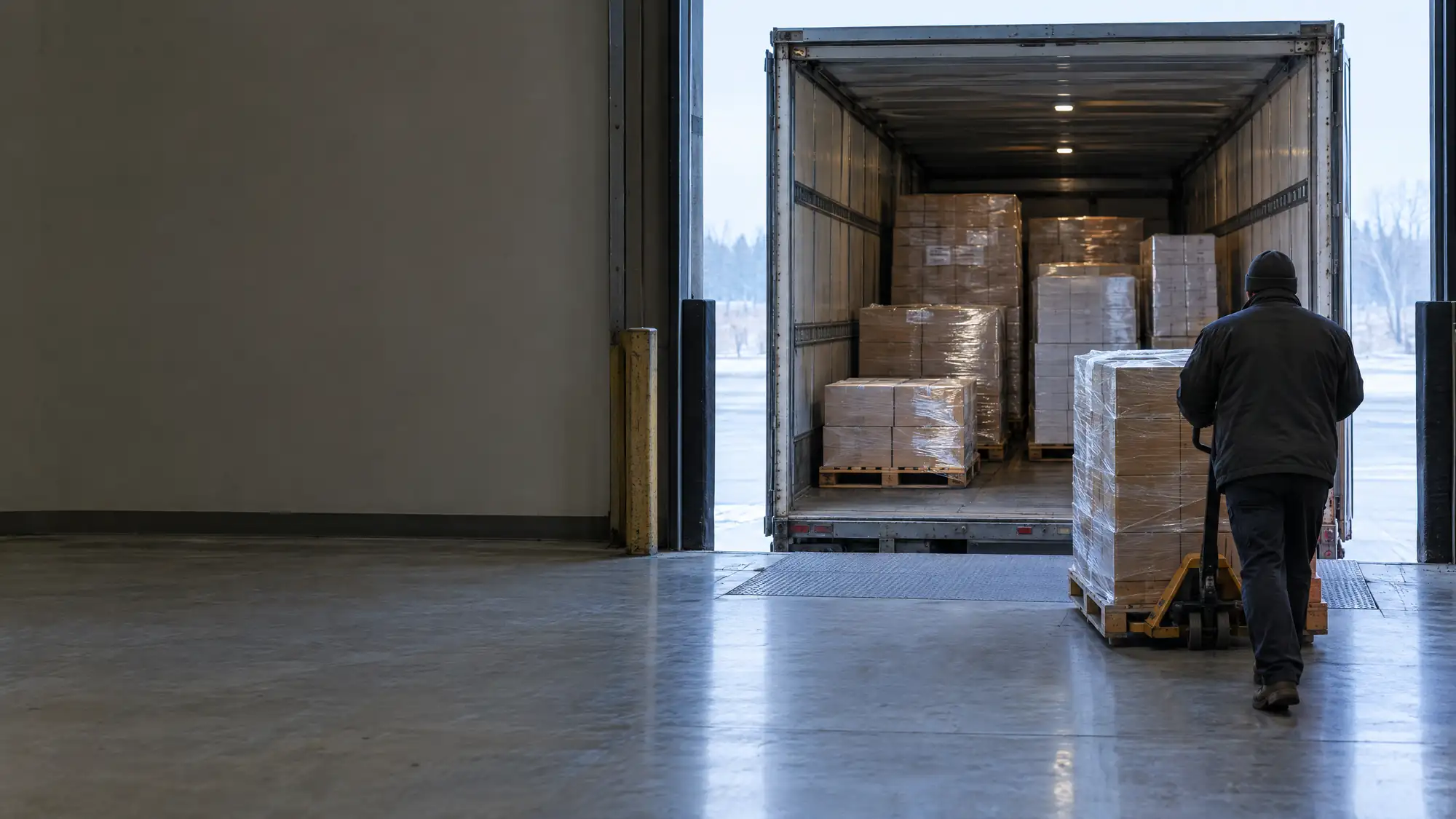
LTL (less-than-truckload) shipping moves freight that is too big for parcel and too small to fill a trailer. Your pallets share a truck with other shippers' freight, and you pay for the space and handling you use. For natural, organic, and other CPG brands it is the usual way one to a few pallets reach a distributor, retailer, or co-packer.
Licensed and bonded freight broker in Valencia, CA · NMSDC minority-certified · CarrierSource Top Brokerage 2026
LTL shipping, short for less-than-truckload shipping, is how CPG brands usually move one to five pallets at a time. Instead of paying for a whole trailer, your pallets ride with LTL freight from other shippers. The carrier moves everything through its terminals. Your pallets are picked up, sorted, carried between cities, sorted again, and delivered. Fr8topia is a licensed freight broker in Valencia, California. It arranges LTL through a vetted carrier network, built first for natural and organic brands.
How an LTL shipment moves
Those handoffs are why LTL costs less per pallet than a dedicated truck, and why it takes longer. Each handoff is also a chance for damage or a delay.
That shared network is what makes LTL affordable for small shipments. It is also why LTL is slower than a dedicated truck and why your freight is handled more. For a natural or organic brand shipping into a distributor, the handling and the timing matter as much as the price. A damaged case, a late arrival, or paperwork that does not match can come back weeks later as a deduction.
LTL shipping rates come from four things: freight class, the lane, the weight, and any extra charges. Weight is only one of them, and since 2025 density counts for more.
Freight class and density
Carriers price by freight class. For many products the class now comes mainly from density: the pallet's weight divided by its size.
Lane
Distance and the pickup and delivery ZIP codes. Busy lanes between major hubs usually price better than remote ones.
Weight
Heavier shipments cost more in total, but the rate per pound usually drops as weight goes up.
Extra charges
A liftgate, a delivery appointment, a residential address, or a reweigh all add to the bill. They are listed below.
A light, bulky pallet can cost more to ship than a heavy, compact one.
What changed in 2025. On July 19, 2025, the National Motor Freight Classification (NMFC) moved many commodities to classes based mainly on density. The NMFC now measures density on a new 13-tier scale. For a CPG brand that means the dimensions on your bill of lading matter as much as the weight. If a carrier measures your pallet larger than you declared, expect a reweigh or reclass charge.
Accurate pallet dimensions and weights are the cheapest savings in LTL. So is building square, stable pallets with nothing hanging over the edge. Overhang adds to the measured size and makes damage more likely.
LTL accessorials are charges for anything beyond a standard dock-to-dock pickup and delivery. They are where LTL quotes and LTL invoices stop matching, and most can be avoided if the carrier knows about them before pickup.
| Charge | What triggers it | How to avoid it |
|---|---|---|
| Liftgate | No loading dock or forklift at pickup or delivery. | Ship dock to dock where you can, and say so on the quote request when you cannot. |
| Delivery appointment | The receiver only accepts freight at a booked time, as distributor DCs do. | You will not avoid it for a DC. Price it in, and confirm the appointment is booked before the truck leaves. |
| Residential or limited access | Homes, schools, construction sites, storage units, and some small stores. | Give the full delivery address and location type up front so it is in the rate. |
| Inside delivery | The driver brings freight past the dock or the front door. | Request it only when the receiver needs it. |
| Reweigh and reclass | The carrier measures a different weight, size, or class than the bill of lading shows. | Weigh and measure every pallet, and match the bill of lading to what ships. |
| Redelivery | The first delivery fails: missed appointment, closed receiver, or a refused load. | Confirm receiving hours and the appointment before the truck leaves. |
| Detention | The truck waits too long to be loaded or unloaded. | Have freight ready at pickup time, with paperwork done. |
Charges and their amounts vary by carrier and lane. A quote should list the ones that apply to your shipment.
Use LTL for 1 to 5 pallets and partial truckload for about 6 to 18. Use consolidation for repeat shipments into the same distributor DC, and full truckload when you can fill a trailer. Treat that as a first filter, then price the options side by side.
| Option | Usually fits | Trade-off |
|---|---|---|
| LTL | 1 to 5 pallets, irregular shipments | Lowest cost for small shipments, but more handling and slower transit. |
| Partial truckload | About 6 to 18 pallets | Shares a trailer with one or two other shipments: fewer stops, less handling, and you still pay only for your share. |
| Consolidation | Repeat shipments into the same distributor DC | Your pallets combine with other brands' freight headed to the same DC on one appointment, at a per-pallet price. |
| Full truckload | Enough freight to fill a trailer | Fastest and least handled, but you pay for the whole truck. |
See how retail consolidation programs work, or work out what freight does to your margin with the landed freight cost per case guide.
Distributor and retailer DCs take LTL freight all the time, but they run on rules that a parcel shipment never meets. These four are where LTL turns into deductions.
For dry LTL into UNFI and KeHE, Fr8topia books the delivery appointment for you. Start with the UNFI and KeHE compliance hub, or see the receiving details for UNFI and KeHE.
Amazon LTL. Fr8topia also ships LTL into Amazon fulfillment centers. Amazon runs its own appointment, pallet, and labeling rules, separate from the distributors. Send your Amazon shipment details with the quote request.
Shelf-stable product moves in standard dry trailers through the regular LTL network. Chilled and frozen product needs refrigerated LTL, which runs on fewer lanes and fixed schedules and costs more. If your product needs temperature control, see refrigerated LTL.
Booking an LTL carrier directly suits steady, high-volume lanes. An LTL freight broker suits irregular volume and many delivery points. It also suits freight where retailer compliance rides on each delivery.
Fr8topia is a licensed freight broker, not a carrier. We source and manage a vetted carrier network, book the delivery appointment, and keep the paperwork. For the cost side, see what CPG brands really pay for freight brokerage.
An accurate LTL freight quote needs six details. With them, the rate comes back right the first time and the invoice matches the quote.
Tell us what you are shipping and where it needs to be. Our team responds with a rate within two business hours.
Or call (909) 304-1068, Monday to Friday, 8 to 5 Pacific.
Send us the shipment details. We come back with a rate within two business hours and book the delivery appointment for you.
Page last updated October 18, 2026. 2025 NMFC density-based classification changes, effective July 19, 2025: National Motor Freight Traffic Association, "2025 NMFC Changes" (info.nmfta.org/2025-nmfc-changes), retrieved October 18, 2026. Pallet ranges for LTL and partial truckload reflect the ranges Fr8topia publishes elsewhere on this site. Extra charges vary by carrier and lane.