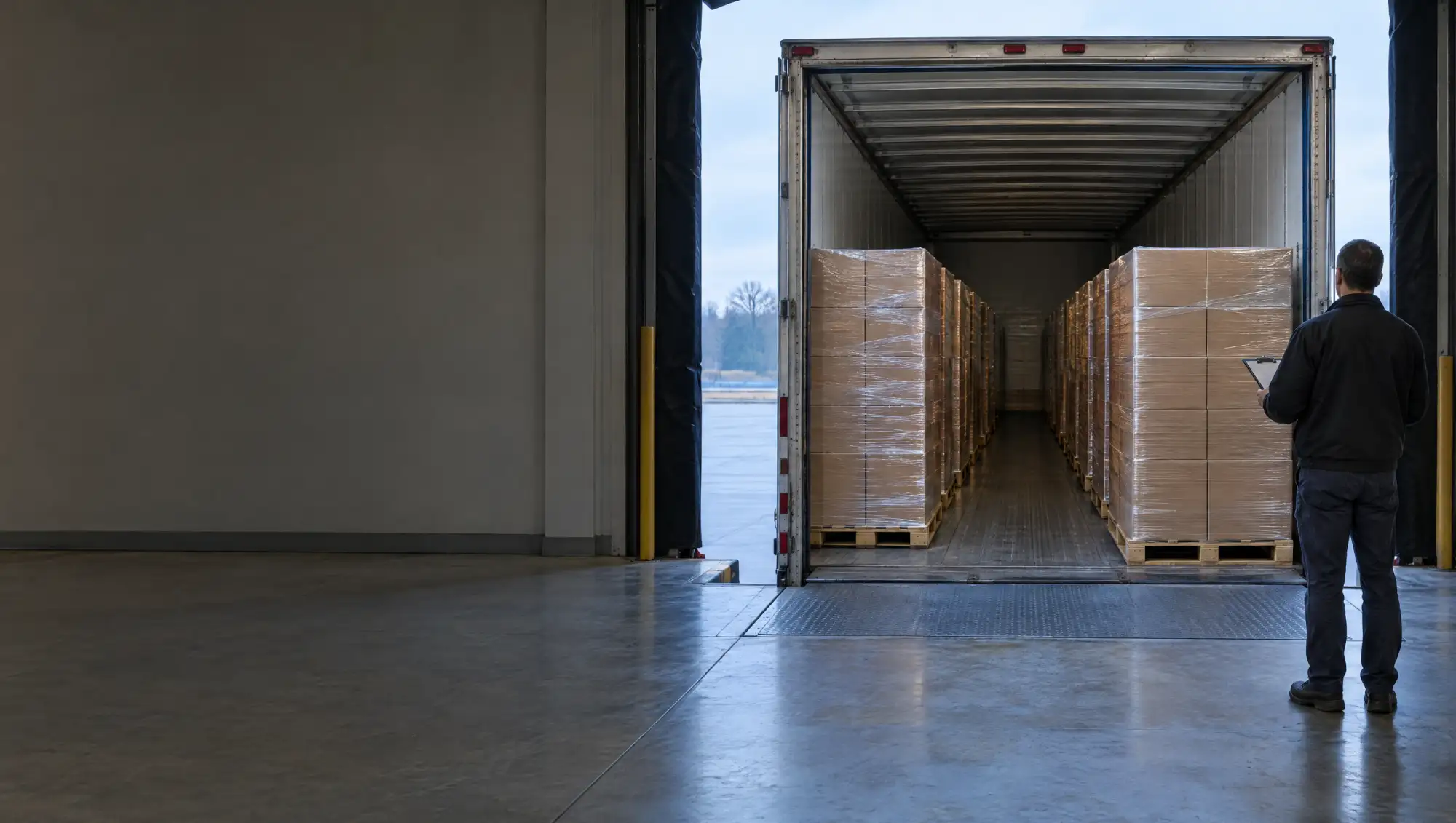
Worker with a clipboard beside a trailer loaded nose to tail with shrink-wrapped pallets of cartons at an open dock door
Full truckload freight

Truckload freight shipping for CPG brands

Full truckload (FTL) shipping gives your freight a whole trailer. The truck picks up at your dock and drives straight to one destination, with no terminal stops. For natural, organic, and other CPG brands it makes sense once an order fills most of a trailer. It also makes sense when the delivery window is too tight to share a truck.

  • Dry van and refrigerated truckload
  • Delivery appointments booked for you
  • Vetted carrier network
  • A rate within 2 business hours

Licensed and bonded freight broker in Valencia, CA  ·  NMSDC minority-certified  ·  CarrierSource Top Brokerage 2026

What is full truckload shipping?

Full truckload shipping means one shipper's freight gets the whole trailer. It loads at your dock, runs direct, and unloads at one receiver, with no terminal sorting in between. Shelf-stable CPG product usually moves in a 53-foot dry van. Fr8topia is a licensed freight broker in Valencia, California. It arranges truckload freight through a vetted carrier network, built first for natural and organic brands.

One shipper

The trailer is yours

No other shipper's pallets get loaded on top of yours or unloaded at a stop before yours.

Direct run

Dock to dock

The truck goes from pickup to delivery without terminal stops. That means faster transit and less handling.

Dry van

The standard trailer

An enclosed, unrefrigerated trailer for shelf-stable product. Chilled and frozen loads use a refrigerated trailer instead.

Pricing

You pay for the truck

The rate covers the whole trailer whether you fill it or not. That is why it pays off once your order fills most of it.

LTL vs FTL: which fits your shipment?

Use LTL for 1 to 5 pallets and partial truckload for about 6 to 18. Use consolidation for repeat shipments into the same distributor DC, and full truckload when your order fills most of a trailer. Treat that as a first filter, then price the options side by side.

OptionUsually fitsTrade-off
LTL1 to 5 pallets, irregular shipmentsLowest cost for small shipments, but your freight moves through terminals, so it is handled more and arrives slower.
Partial truckloadAbout 6 to 18 palletsShares a trailer with one or two other shipments. Fewer stops than LTL, and you pay only for your share.
ConsolidationRepeat shipments into the same distributor DCYour pallets combine with other brands' freight headed to the same DC, on one appointment.
Full truckloadAn order that fills most of a trailer, or a window too tight to share a truckFastest and least handled. You pay for the whole trailer, so a half-empty truck costs more per pallet.

A 53-foot dry van typically holds 26 standard pallets loaded single.

Signs it is time for a full truck. Your partial or LTL quote comes close to the price of a whole trailer. The purchase order has a tight must-arrive-by date that terminal stops could miss. Or the product is fragile, high value, or stacked high enough that every extra handling is a risk.

For smaller orders, see LTL shipping for CPG brands or how retail consolidation programs work. To see what each option does to your margin, use the landed freight cost per case guide.

How much does truckload freight cost per mile?

Truckload freight is priced for the whole trip, and dividing it by the miles gives the rate per mile. That rate moves with the lane, fuel, the equipment, timing, and how tight trucks are that week, so a national average is only a starting point.

Lane and miles

Where it starts and ends

Distance sets the base. Lanes into busy freight markets often price better than lanes into places trucks struggle to leave with a load.

Fuel surcharge

Diesel, passed through

Most rates add a fuel surcharge tied to diesel prices. Ask whether a quote includes it, so you compare like with like.

Equipment

Dry van or refrigerated

Refrigerated trailers cost more than dry vans on the same lane, because the trailer and its fuel cost more to run.

Timing and market

When you book

Short notice, holidays, and month or quarter end all push rates up. Spot rates move with the market week to week.

A per-mile average is a starting point. The lane sets the real price.

Compare quotes all in: linehaul, fuel, and the extra charges that apply. A low linehaul can still end up the bigger bill once a lumper fee or detention is added. For how a freight broker's price breaks down, see freight broker fees explained.

What extra charges come with a truckload?

Truckload extra charges, called accessorials, cover anything beyond a standard pickup and delivery. They come from waiting, unloading, or a change of plan, and many can be avoided if they are planned for before the truck is booked.

ChargeWhat triggers itHow to avoid it
DetentionThe truck waits past its free time to be loaded or unloaded.Have the freight built and the paperwork done at pickup. Book a delivery appointment the receiver can meet.
LayoverThe driver is held overnight because pickup or delivery slips to the next day.Confirm the ready time and the appointment before dispatch.
Truck ordered not used (TONU)The load is cancelled after the truck has been dispatched.Cancel as early as you can, and agree a cancellation cutoff when you book.
Lumper feeA third-party crew unloads the truck at the receiver, common at grocery and distributor DCs.Expect it at DCs that use lumpers. Ask that it be passed through at cost, with a receipt.
Driver assistThe driver helps load or unload instead of staying with the truck.Say so on the quote request, so it is priced in.
Extra stopThe load picks up or delivers at more than one location.List every stop up front.
RedeliveryThe receiver refuses the load or the truck misses its window.Match the paperwork to the purchase order and protect the appointment.

Charges and their amounts vary by carrier, lane, and receiver. A quote should list the ones that apply to your load.

How do you ship a truckload into UNFI, KeHE, and retail DCs?

Distributor and retailer DCs receive full truckloads every day, on strict rules. With a whole order on one truck, one late arrival makes the entire purchase order late. These five rules matter most.

  • The delivery appointment. DCs receive by appointment. A truck that misses its window can be refused, and a refused truckload is a full order of freight sitting in the yard.
  • The must-arrive-by date. The purchase order sets a delivery window, and arriving early can count as a miss. See MABD explained.
  • The routing guide. Each distributor publishes how it wants freight to arrive: pallet build, labels, and paperwork. The details live in its current routing guide, and they change.
  • Paperwork that matches. The bill of lading, the purchase order, and the case count have to agree. A mismatch is one of the most common causes of a chargeback.
  • Unloading. Many DCs use lumpers to unload, and the fee is paid at the dock. Plan for it so it does not hold the truck.

Fr8topia books the delivery appointment and keeps the paperwork for every load. Start with the UNFI and KeHE compliance hub, see the receiving details for UNFI and KeHE, or read what to do in the first hour when a carrier does not show.

Spot or contract: how should you buy truckload freight?

Buy one-off loads at spot rates, and lanes you ship on a steady schedule on contract rates. A brand can use both at the same time.

Spot rates suit

  • A first order or a one-off promotional load
  • Lanes you ship only now and then
  • Weeks when the market is soft and trucks are easy to find

Contract rates suit

  • The same lane on a regular cadence
  • Volume you can forecast for the next few months
  • Brands that want the same price when the market tightens

What does a truckload freight broker do?

A truckload freight broker finds a qualified carrier for each load and negotiates the rate. It also books the appointment and follows the load to delivery. Booking carriers directly suits shippers with steady, high-volume lanes and a team to run them. A freight broker suits brands with irregular volume, many delivery points, and retailer rules on every load.

Book a carrier directly when

  • You ship the same lanes every week
  • Your volume is high enough to earn a carrier's attention
  • Someone on your team vets carriers, books appointments, and handles claims

Use a freight broker when

  • Your volume is irregular or growing
  • You deliver to several distributors and retailers with different rules
  • You want one contact for the carrier, the appointment, and the paperwork
  • Deductions are already costing you money

Fr8topia is a licensed freight broker, not a carrier. We source and manage a vetted carrier network, book the delivery appointment, and keep the paperwork. For the cost side, see what CPG brands really pay for freight brokerage.

Dry van or refrigerated truckload?

Shelf-stable product ships in a dry van. Chilled and frozen product needs a refrigerated trailer set to the right temperature, which costs more on the same lane. For cold loads, see refrigerated freight. If you ship the same cold lane often, see committed reefer lanes.

What do you need for a truckload freight quote?

An accurate truckload quote needs six details. With them, the rate comes back right the first time and the invoice matches the quote.

  • Pickup and delivery ZIP codes, and any extra stops.
  • Ready date, and the date or window it must arrive.
  • Pallet count and total weight, and whether the pallets can be stacked.
  • What the product is, and whether it needs temperature control.
  • Delivery appointment or routing guide requirements at the receiver.
  • Loading and unloading: dock or no dock, driver assist, or a lumper at the DC.

Get a truckload quote

Tell us what you are shipping and where it needs to be. Our team responds with a rate within two business hours.

Or call (909) 304-1068, Monday to Friday, 8 to 5 Pacific.

Frequently asked questions

What is the difference between LTL and FTL?
LTL (less-than-truckload) puts your pallets on a shared trailer that moves through carrier terminals, and you pay for the space you use. FTL (full truckload) gives your freight the whole trailer, with a direct run from pickup to delivery. FTL is faster and handled less. LTL costs less for a few pallets.
What do FTL and LTL mean?
FTL stands for full truckload: one shipper's freight fills or books the whole trailer. LTL stands for less-than-truckload: several shippers' freight shares one trailer. Partial truckload sits in between, with your freight sharing a trailer with one or two other shipments.
How many pallets fit in a 53-foot trailer?
A 53-foot dry van typically holds 26 standard 48 by 40 inch pallets loaded single, side by side in two rows. Pallets that can be stacked safely can roughly double that. Weight often runs out before floor space does with heavy products such as beverages, so give the carrier both the pallet count and the total weight.
How much does a full truckload cost?
It depends on the lane, the miles, the fuel surcharge, the equipment, and how tight trucks are that week. Extra charges such as detention or a lumper fee add to it. A per-mile average is only a starting point. The quickest way to a real number is a quote with your pickup and delivery ZIP codes, ready date, pallet count, and weight.
Can you deliver a truckload to UNFI or KeHE?
Yes. Distributor DCs take full truckloads by appointment, and they expect the paperwork to match the purchase order. A truck that misses its window can be refused, and the whole order can turn into a deduction. Fr8topia books the delivery appointment and keeps the paperwork for every load.
Show 7 more questionsShow fewer questions
What is partial truckload?
Partial truckload is for shipments too big for LTL but too small for a whole trailer, usually about 6 to 18 pallets. Your freight shares a trailer with one or two other shipments. It avoids terminal handling, and you pay only for your share of the trailer.
When should I switch from LTL to full truckload?
Price both once you ship more than a handful of pallets to one place. Switch when the LTL or partial quote gets close to the price of a whole truck. Also switch when the delivery window is too tight for terminal stops, or when the product is fragile enough that every extra handling is a risk.
What does a truckload freight broker do?
A truckload freight broker finds and books a qualified carrier for each load, so you do not have to. It also books the delivery appointment, tracks the load, and keeps the paperwork. Fr8topia is a licensed freight broker with a vetted carrier network. It is not a carrier.
What is the difference between spot and contract truckload rates?
A spot rate is a price for one load today, set by the market that week. A contract rate is agreed ahead of time for a lane you ship on a regular schedule, usually for months. Spot suits one-off loads. Contract suits steady volume, because the carrier can plan around it.
What is detention, and how do I avoid it?
Detention is a charge for keeping a truck waiting too long to be loaded or unloaded. Avoid it at pickup by having the freight built and the paperwork done before the truck arrives. At delivery, it helps to book an appointment the receiver can actually meet.
How far ahead should I book a truckload?
Book as soon as the purchase order and ship date are confirmed. More lead time means more carrier options and usually a better rate. Book earlier around holidays and at month or quarter end, when trucks get tighter.
Do you handle refrigerated truckload?
Yes. Chilled and frozen loads ship in refrigerated trailers, set to the temperature the product needs. They can move as full or partial truckloads.

Book your next truckload without the deductions

Send us the load details. We come back with a rate within two business hours and book the delivery appointment for you.

Sources

Page last updated October 23, 2026. Pallet ranges for LTL and partial truckload match the ranges Fr8topia publishes on its LTL shipping page. Pallets per trailer is a typical figure for standard 48 by 40 inch pallets in a 53-foot dry van; the real count depends on pallet size, stacking, and weight. Rates and extra charges vary by carrier, lane, and receiver.