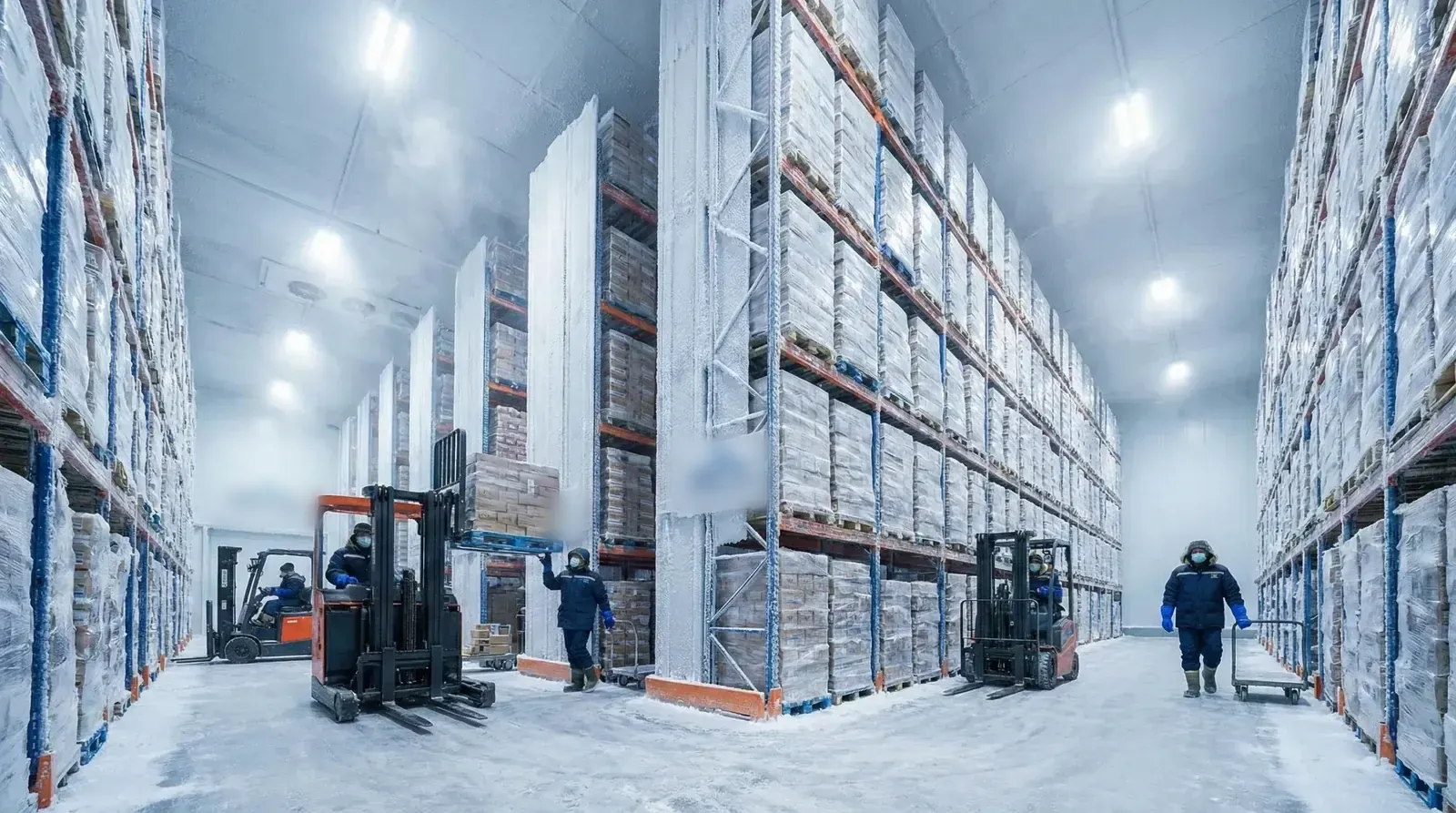
Cold storage failure playbook
When cold storage goes down: an emergency playbook for CPG brands
Licensed and bonded FMCSA broker · NMSDC minority-certified · CarrierSource Top Brokerage 2026
When a cold storage facility fails, work the product clock: get actual temperatures, keep doors closed, and triage inventory by temperature band and code date. Refrigerated trailers can hold product at the dock while replacement space is arranged, and a broker coordinates both: emergency reefer capacity and backup food-grade cold storage.
The call comes from the facility, not from you checking a dashboard. A compressor failed overnight, the frozen room is drifting, and the only update is "we are working on it." Your inventory is sitting in that room with code dates printed on every case and purchase orders already scheduled against it. The founder version of this story ends with product loaded into refrigerated trailers in the yard because nobody had a better plan. Here is the thing: the trailers are actually a legitimate move. The difference between panic and a plan is knowing when to make that move, and what to check before you trust a trailer with your inventory.
"We are working on it" is not information. Ask the facility four things: the actual room temperature right now, when the failure started, what specifically broke, and whether they have backup, a generator, a spare room, anything. Then ask for product temperatures, not just air. A full frozen room holds cold in the product long after the air reading drifts, and the pulp number is the one your decisions hang on.
Doors stay closed while you rank the inventory. Fresh and dairy have the tightest window, refrigerated product next, and deep frozen in a dense room is the most forgiving. Cross that against code dates and against which purchase orders ship soonest, because the case that ships Monday matters more than the one that ships next month. You are deciding what moves first if moving becomes necessary.
Work both options in parallel. Refrigerated trailers at the dock buy time if they are done right: precooled to setpoint before loading, running continuously, fueled, with someone named to check them overnight. Meanwhile, start the search for backup food-grade cold storage, because a trailer is a bridge, not a destination. And if any purchase order is now at risk, call the receiver's scheduling desk before the appointment is missed. A proactive reschedule is a different conversation than a silent miss.
The causes are a short list, and knowing which one you have changes your timeline:
A compressor with a repair ETA is a different problem than an evacuation with no re-entry time. Ask which one you have before deciding how much to move.
A full frozen room protects itself. The product holds the cold long after the air does not.
Frozen inventory has thermal mass, which is why product temperatures matter more than air alarms. A dense, full room can hold product at spec for hours after the air reading starts drifting, and that window is your planning time. It is bought entirely with door discipline: every opening spends cold you cannot get back. Measure pulp temperatures, do not infer them from the air.
Loading inventory into refrigerated trailers in the yard is not a desperation move, it is a recognized emergency practice, and the difference between doing it right and doing it badly is a checklist: the trailer is precooled to the product's setpoint before anything loads, it runs continuously rather than on a start-stop cycle, fuel is confirmed and someone owns checking it overnight, and the setpoint and load time go into the record.
Sourcing those trailers fast is a market problem, which is what a broker is for. Fr8topia manages a refrigerated carrier network and arranges food-grade, multi-temperature warehousing in Southern California, which is exactly the pairing this failure calls for: trailers to hold the line today, and a landing spot that keeps the chain intact after. The Southern California cold storage cluster runs through Vernon, Commerce, and the City of Industry, and knowing which facilities have space this week is local knowledge.
If purchase orders are attached to the affected inventory, the freight problem becomes a compliance problem. Appointment desks reschedule on their own calendar, so the call to the receiver's scheduling desk happens before a window is missed, not after, the same principle as a carrier no-show. For food, the bar is higher still: under the FDA's sanitary transportation rules, product that may have left its safe range does not ship until someone qualified says it is safe, which makes the temperature record the most valuable thing you own.
When the room is stable again, the decision of what ships, what gets tested, and what gets written off belongs to your QA contact or co-packer's lab, and it runs on the packet you built during the failure: timestamps, minimum and maximum temperatures, how long product sat out of range, photos, and what moved where. That same packet is what your insurer and the facility's warehouse liability terms will be argued over. Document first, sort liability second.
If a cold storage failure has you sourcing reefer trailers or backup space in Southern California right now, tell us what is at risk and where it sits, or call (909) 304-1068. Fr8topia is a licensed freight broker, and emergency capacity starts with a fast quote.
The time to ask these is before a failure, when you are choosing partners, and during one, when you are deciding who to trust:
Curated from trade press and law enforcement advisories. Each entry links to the original source.
Two shipments left an Anheuser-Busch distribution center in Montclair on Aug 17 and never arrived. Police say a purported subcontractor used fraudulent paperwork, and the same broker arranged both pickups.
A driver used fraudulent paperwork to collect a Dallas-bound Nike shipment in Memphis. Cook County investigators traced it to a Des Plaines facility and recovered roughly $647,000 in merchandise alongside a stolen trailer.
A stolen-load alert led an Arizona detective to a suspect trailer on I-40. Coordinating with Phoenix police, officers intercepted a second stolen load on I-10, recovering about $400,000 in two stops 20 minutes apart.
Overhaul logged 605 reported thefts in Q2, up 5% from Q1. California accounted for 34% of cases, and the area within 200 miles of Torrance drew 37% of all US thefts. Deceptive pickups rose to 28% of Southern California incidents.
Five suspects were arrested in a Southern California rail cargo theft investigation after a report of shots fired from a moving BNSF train.
Longer than the air temperature suggests, and less than you hope. A densely loaded frozen room holds cold in the product itself for hours after the air drifts, which is why product temperatures matter more than air alarms. How long depends on load density, starting temperature, and door discipline, so measure rather than guess, and triage by code date.
Yes, and it is a recognized emergency move. Done right, the trailer is precooled to the product's setpoint before loading, run continuously rather than on a start-stop cycle, fueled, and checked on a schedule. Done wrong, it is an unmonitored box in a yard. The difference is monitoring and documentation.
It depends on the storage contract, the facility's warehouse liability terms, and the insurance in play, which is why the record matters: temperature logs, timestamps, photos, and what moved where. Document first and sort liability second, and involve your insurer early.
Call the scheduling desk before an appointment is missed, not after. A proactively rescheduled delivery is treated very differently than a silent miss, and it protects the relationship while you move inventory. The same principle applies to any receiver in the natural channel.
Cold chain excursion triage and documentation practice: Tive, "Temperature Excursion Emergency: A Cold Chain Rescue Guide," retrieved August 29, 2026. Food transportation temperature requirements referenced at the level of the FDA Sanitary Transportation Rule. Fr8topia service claims limited to what is published at fr8topia.com as of the same date.
We respond within 2 business hours.